INVISIBLE MONUMENTS: TRIBUTE, MEMORY, AND THE SUMMONING OF THE PAST
Lyons Press (October 2026)
ISBN: 978-1493097289
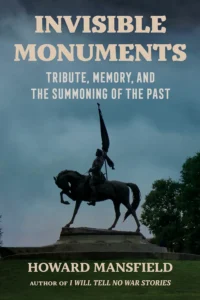
From the Introduction: Bringing the Bones Home
“The Vietnamese believe a person should be buried twice,” says Viet Thanh Nguyen. “The first time, in a field removed from home and village, the earth is allowed to eat the flesh. The second time, the survivors must disinter what remains. They wash the bones with their own hands, and then they bury the bones once more, this time closer to the living.”
We do the same. When we commission memorials, we are trying to bring the bones closer to home. The memorials we build are a second burial. In all the current controversies about what to build and how, and what to tear down, we’ve lost track of why we build monuments. We want the counsel of our ancestors – edited, and chiseled into stone.
But most monuments melt into invisibility. We argue about their design, dedicate them with grand ceremonies, and walk away. They are seldom noticed again. Daily life pushes them aside. Tons of the finest granite, marble, and bronze prove to be insubstantial, vaporized by our indifference. We fail to summon our ancestors.
The stones don’t talk to us; muteness defines monuments. “What strikes one most about monuments is that one doesn’t notice them. There is nothing in this world as invisible as monuments,” said the Austrian writer Robert Musil in 1927. And yet we are in the midst of a boom in building monuments. We want to bring the bones home.
At the Place of the Invisible Monument explores how we try to keep our ancestors near, looking at moments of commemoration or the failure to commemorate….
After the Civil War, towns and cities summoned a standing army of zinc soldiers, ready-made statues that could be ordered from a catalog. One company that sold these statues promised that zinc would “last as long as the Pyramids of Egypt.”
Few things do. And that doesn’t matter. It’s the moment of commemoration that matters, the washing of the bones and their reburial.
Anthropologist Michael Blakely, who oversaw the study of Manhattan’s African Burial Ground, says: “I sometimes think that we should be called homo reminiscens, not sapiens, that what distinguishes us is that we are the memorializers.”
We are like the ancient Achlipa in Australia’s outback. They carried their sacred pole, the center of their universe. As long as they had their pole, they were sure of their place in the cosmos; their ride around the sun was a ceremonial procession in a greater drama. The mundane was sacred. And when the pole broke, when they lost contact with their ancestors, they lay down and wept.